Every redesign pitch ends with the same promise: less friction. Fewer clicks, faster paths, higher conversion. It’s the easiest sell in the industry because it’s the easiest thing to screenshot for a client deck.
But talk to Brian McGovern and Joel Macaluso, the technical leads at iMedia, and you’ll hear a version of friction most agencies never put in a report.
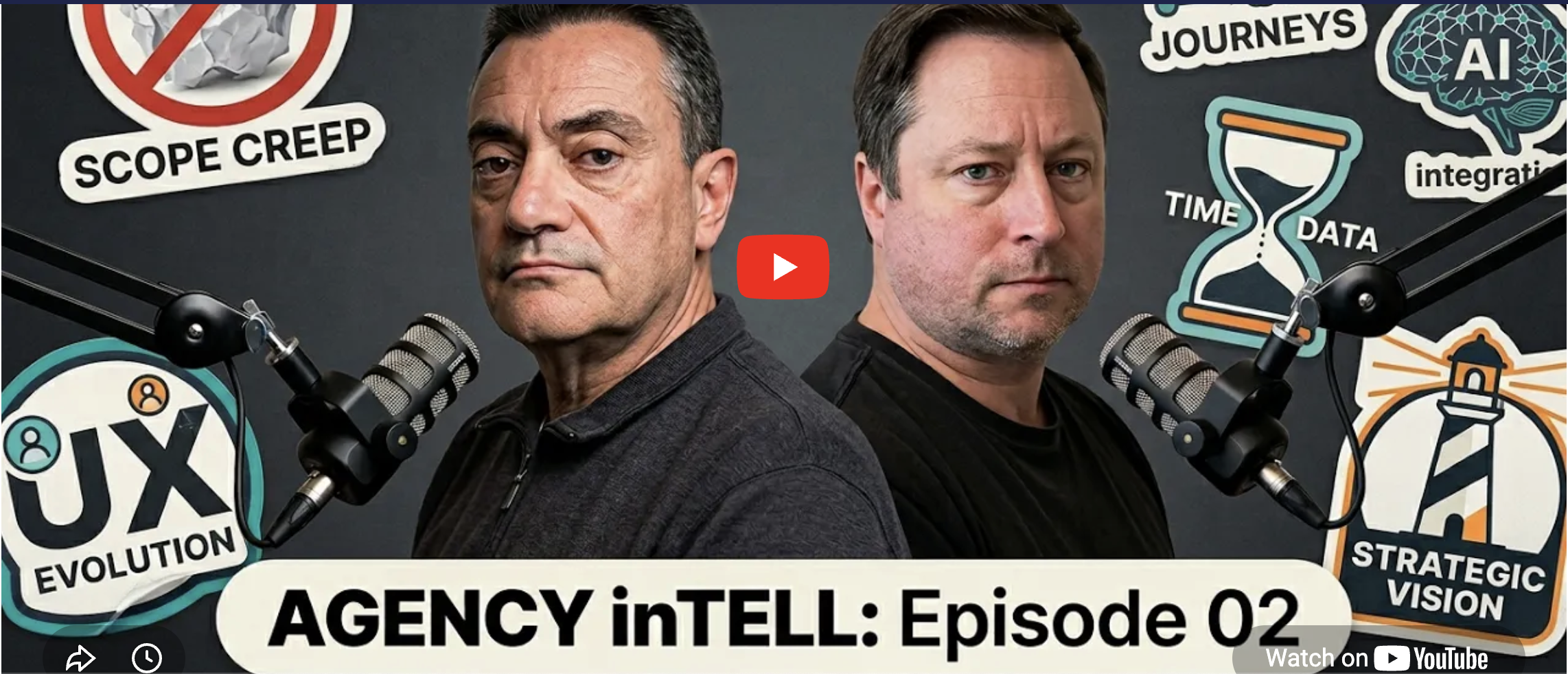
On the 2nd episode of Agency inTELL, Brian walked us through how iMedia actually measures a redesign. Conversion rate is the headline number, sure. But he pairs it with something quieter: pages per session. If conversion goes up while pages per session goes down, that’s a clean signal. Visitors are finding what they need in fewer steps. Friction, measured and confirmed.
That’s the front of the site. iMedia treats the back of the site the same way.
“There’s a whole editorial experience on the back end,” Brian told us. “The owners of the site, the ones who are managing it, they have to be able to edit it quicker.” No analytics dashboard tracks that number. It shows up in client feedback instead, in comments like “we’re really loving this new CMS because it’s reducing our time to do tasks.” That’s friction too. It just never makes it into the slide deck, because nobody built a chart for it.
This distinction matters more than it sounds like it should. A redesign can hit every front-end target and still be a failure six months later, if the marketing team on the client side is fighting the CMS every time they need to publish a page. That frustration rarely gets reported back to the agency directly. It shows up as a client who’s harder to reach for the next project, or a renewal conversation that goes sideways for reasons nobody can quite name.
iMedia’s answer is to build both sides of the friction question into how they scope and report on work from the start. Before a redesign, they’re asking not just “what’s slowing down the visitor” but “what’s slowing down the person who has to maintain this site every week for the next three years.” After launch, they’re not just pulling conversion numbers. They’re asking the client’s team directly whether their job got easier.
It’s a small shift in what gets measured, but it changes what gets built. A search feature that’s blazing fast for visitors and a nightmare for editors to configure isn’t a win. Neither is a beautifully composable content model that takes a marketing coordinator four times as long to update as the old monolith did.
If you’re running client reports right now, this is worth an honest look. Are you only telling the half of the friction story that’s easy to graph? The other half is sitting in your client’s inbox, in the comments people make on calls but never write down. It won’t show up in Google Analytics. It’ll show up in whether they call you again.
The full conversation with Brian and Joel covers a lot more than this, including how iMedia engineered ticketing infrastructure for the San Francisco Symphony and why they’ve deliberately stayed CMS-agnostic for 25 years. Worth the full listen on Episode 2 of Agency inTELL.